Accessibility is not just a courtesy in California, it is the law. For property owners and businesses in Santa Ana, ensuring that premises are accessible to individuals with mobility impairments is a legal obligation governed by both federal and California state regulations. Among the most visible and essential elements of physical accessibility is the handicap ramp, also known as an accessible ramp or ADA ramp. Whether installed at a building entrance, a parking lot, a curb transition, or along a public sidewalk, these ramps must meet precise standards to provide safe, dignified access for wheelchair users, scooter users, and individuals with other mobility challenges. This article explains what Handicap Ramp Installation Santa Ana involves in Santa Ana, the applicable ADA and California-specific requirements, the different types of ramps, and the installation process.
Why Handicap Ramps Are Required in Santa Ana
The Americans with Disabilities Act (ADA), signed into federal law in 1990, prohibits discrimination against individuals with disabilities in all areas of public life. For built environments, this means that businesses, public facilities, and multi-family residential properties must provide accessible routes that allow people with mobility impairments to reach the same destinations that non-disabled people can access.
In California, the ADA is supplemented by California Title 24 the California Building Code which in many cases imposes stricter accessibility requirements than the federal ADA standards. Together, these regulations govern how ramps are designed, constructed, and maintained. California also enforces accessibility requirements through the Unruh Civil Rights Act, which enables individuals who experience discrimination due to inaccessible facilities to seek legal remedies.
For Santa Ana property owners and businesses, non-compliance with handicap ramp requirements creates real risks:
Legal Liability: Failure to provide accessible ramps can expose property owners to ADA lawsuits and state civil rights claims.Regulatory Penalties: CASp (Certified Access Specialist) inspections that reveal non-compliant ramps can result in required corrections, permit delays, and fines.Safety Hazards: Non-compliant ramps those that are too steep, too narrow, or have poor surfaces create genuine safety risks for users.
Federal ADA vs. California Title 24 Ramp Requirements
Understanding the relationship between federal ADA standards and California’s Title 24 code is essential for property owners in Santa Ana:
Federal ADA Standards: The federal ADA Standards for Accessible Design set minimum requirements for ramp slope (maximum 1:12), clear width (minimum 36 inches), landing dimensions, handrail specifications, edge protection, and surface materials. These apply to facilities used in connection with commercial activity or publicly accessible services.
California Title 24 (CBC): California’s building code is generally stricter than the federal ADA in several respects. For example, California requires a minimum clear width of 48 inches between handrails, compared to the federal 36-inch minimum. California also specifies more detailed requirements for landing geometry, handrail extensions, detectable warning surfaces, and edge protection.
For property owners in Santa Ana, the stricter California standard prevails. This means ramps that meet federal ADA minimums may still fail a CASp inspection in California if they do not meet Title 24 requirements.
Key ADA and California Requirements for Handicap Ramps
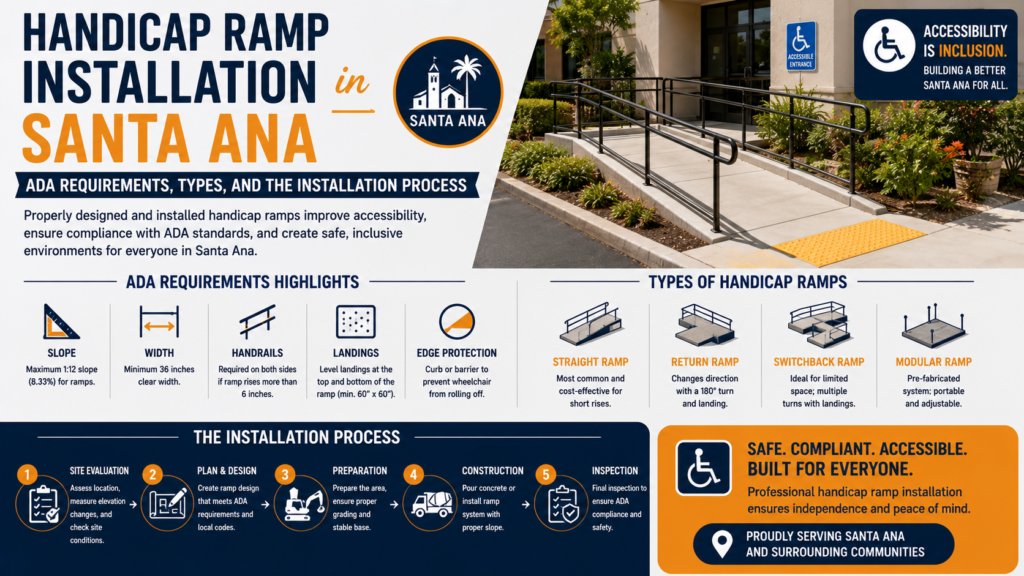
The following are the core technical requirements that handicap ramps in Santa Ana must meet:
Slope: The maximum running slope is 1:12 meaning one inch of vertical rise for every 12 inches of horizontal run. This translates to an 8.33 percent maximum slope. Steeper slopes are not permitted in new construction. The cross slope (side to side) cannot exceed 1:48 (approximately 2 percent), ensuring the ramp does not cause wheelchairs to drift laterally.
Width: California requires a minimum clear width of 48 inches between handrails. The federal ADA minimum is 36 inches, but California’s stricter standard applies in Santa Ana.
Maximum Rise Per Run: Each uninterrupted ramp run can have a maximum vertical rise of 30 inches. If the required rise exceeds 30 inches, an intermediate landing must be provided before the ramp continues.
Landings: Level landings must be provided at the top and bottom of each ramp run, and at each change in direction. Landings must be at least 60 inches long in the direction of travel. Top landings must be at least 60 inches wide. Bottom landings must extend 72 inches in the direction of travel beyond the base of the ramp.
Handrails: Handrails are required on both sides of ramps that have a rise greater than 6 inches. Handrails must be mounted at 34 to 38 inches above the walking surface, be continuous along the full length of the ramp run, and extend at least 12 inches beyond the top and bottom of each run. The gripping surface must have a circular cross-section of 1.25 to 2 inches in diameter.
Surface: Ramp surfaces must be firm, stable, and slip-resistant. Smooth, polished surfaces or surfaces with seams or gaps that could trap wheelchair wheels are not acceptable.
Edge Protection: Ramps and landings must have edge protection either extended surfaces, curbs, or railings to prevent wheels from going off the edge. A minimum 2-inch-high curb is typically required where no other edge protection is present.
Detectable Warning Surfaces: At public rights-of-way such as curb ramps at street crossings truncated dome detectable warning surfaces are required to alert visually impaired pedestrians of the transition from sidewalk to street.
Types of Handicap Ramps Installed in Santa Ana
Different site conditions call for different ramp configurations:
Curb Ramps: These ramps cut through an existing curb or are built up to a curb to provide a smooth transition from the sidewalk to the street level. They are required at pedestrian crossings throughout Santa Ana’s public rights-of-way. Curb ramps may be perpendicular (running directly through the curb) or parallel (running along the curb line).
Building Entrance Ramps: Installed at the entrance to commercial buildings, restaurants, offices, and other facilities to provide accessible access to the main entry point. These ramps must connect accessible parking areas to building entrances along an accessible route.
Parking Lot Ramps: Where parking lots have grade changes, ramps provide accessible transitions between different elevation levels. These must connect accessible parking spaces to the accessible route leading to the building entrance.
Interior Ramps: Used within buildings where level changes exist that are not served by elevators or lifts. These follow similar slope and width requirements as exterior ramps.
Modular and Portable Ramps: While permanent concrete ramps are standard for commercial properties in Santa Ana, temporary or modular ramps made from aluminum or other materials are used in situations where permanent construction is not feasible or where temporary access is needed.
The Handicap Ramp Installation Process
Installing a code-compliant handicap ramp in Santa Ana involves careful planning and precise construction:
Site Assessment: The contractor begins by evaluating the site measuring existing grades, identifying the required rise and run, checking for utility conflicts, and assessing the condition of adjacent surfaces. This information determines the ramp design that will achieve the required slope within the available space.
Design and Permits: For most commercial and public-access ramp installations in Santa Ana, building permits are required. The ramp design must be submitted to the City of Santa Ana’s Building Division for plan review. CASp review may also be beneficial to verify compliance before construction.
Subbase Preparation: Existing pavement or soil is excavated to accommodate the ramp foundation. A compacted aggregate subbase is established to prevent settling.
Formwork: Wooden or metal forms are set to define the ramp dimensions, slope, landing areas, and curb edges.
Concrete Placement: Fresh concrete is placed and finished to the required slope and surface texture. The surface must be textured (typically broom-finished) to provide the required slip resistance.
Handrail Installation: After the concrete has cured, handrails are installed on both sides of the ramp to the required height and extension specifications. Handrail supports must be firmly anchored.
Detectable Warning Surfaces: Truncated dome tiles or cast-in-place dome surfaces are installed at the base of curb ramps and other required locations.
Inspection: The completed ramp is inspected by the City of Santa Ana’s Building Department to verify compliance with applicable codes.
Maintaining ADA-Compliant Ramps in Santa Ana
Installation is the beginning, not the end, of ADA compliance for handicap ramps. California’s accessibility regulations require that ramps be maintained in good repair throughout their service life. Common maintenance concerns include:
Surface Deterioration: Cracking, spalling, or settling of the ramp surface can create trip hazards or disrupt the required slope. Periodic inspection allows early identification and repair.
Handrail Stability: Handrails that become loose or damaged must be repaired promptly, as they are critical safety elements for ramp users.
Drainage: Standing water on ramp surfaces creates slip hazards and can accelerate concrete deterioration. Ensuring gutters and drains adjacent to ramps remain clear is important.
Detectable Warning Condition: Truncated dome surfaces that are damaged or missing at curb ramps must be replaced.
Frequently Asked Questions About Handicap Ramp Installation in Santa Ana
Does every building entrance in Santa Ana need a handicap ramp? Not every entrance, but every accessible entrance must have a compliant accessible route, which includes ramps where there is a change in elevation greater than one half inch. Properties with multiple entrances may designate specific accessible entrances, but those must be clearly signed and connected to accessible parking and paths.
Can an existing non-compliant ramp be retrofitted? In many cases, yes. A CASp inspection identifies what must be corrected. Some non-compliant ramps can be modified for example, by reconstructing the slope or adding missing handrails. Others may require full replacement depending on the severity of the deficiency.
What is a CASp inspection? A Certified Access Specialist (CASp) is a professional certified by the State of California to assess buildings and facilities for ADA and Title 24 compliance. A CASp report documents existing conditions, identifies violations, and prioritizes corrective actions.
Are residential homes required to have ADA-compliant ramps? Single-family homes are generally not required to follow ADA standards, which primarily apply to commercial facilities and public accommodations. However, many homeowners install ramps following ADA guidelines as a best practice for safety and usability.
Conclusion
Handicap ramp installation in Santa Ana requires more than pouring concrete it demands a thorough understanding of federal ADA requirements, California Title 24 specifics, and precise construction practices. For property owners and businesses, investing in compliant ramp installation protects against legal liability, ensures accessibility for all visitors and customers, and contributes to a more inclusive community environment.