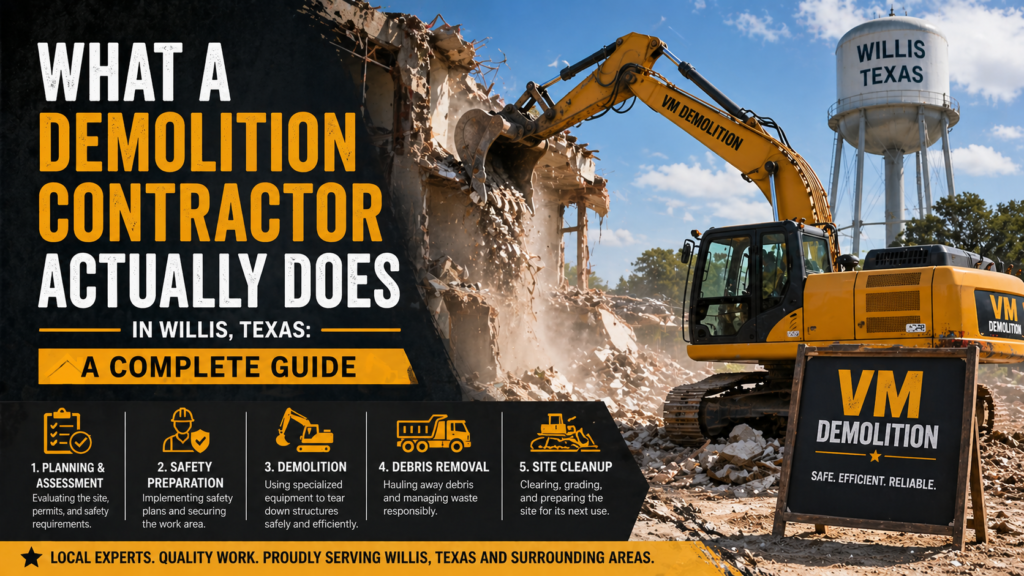
When most people picture demolition, they imagine a wrecking ball swinging into an old building, or an excavator pushing through walls in a cloud of dust. The reality of professional demolition contracting in Willis, Texas is considerably more methodical, technically demanding, and process-driven than that image suggests. Demolition done correctly is a disciplined trade that requires planning, regulatory compliance, equipment expertise, and an understanding of what needs to happen to a site both during and after the structure comes down.
For property owners in Willis and the surrounding Montgomery County area, understanding what a Demolition Contractor Willis actually does and why the process unfolds the way it does makes it easier to approach a demolition project with realistic expectations and a clear sense of what steps are involved.
The Scope of Demolition Contracting
Demolition contracting is not a single activity. It is a category of construction services that includes several distinct types of work, each suited to different situations and project goals.
Structural demolition, sometimes called full demolition, refers to the complete removal of a building or structure down to the foundation. This is what most people think of when they hear the word demolition. It involves taking down walls, roof systems, floor structures, and all associated building components, then removing the resulting debris from the site. Structural demolition is common when a building is too deteriorated for renovation, when the land is being redeveloped for a fundamentally different use, or when fire, flood, or storm damage has compromised a structure beyond the point of practical repair.
Selective demolition, also called interior demolition, takes a more targeted approach. Rather than removing an entire building, selective demolition targets specific interior elements while preserving the overall structure. A homeowner undertaking a major kitchen remodel might need the existing cabinets, countertops, flooring, and walls removed without disturbing the surrounding rooms. A commercial property manager converting office space into a different layout might need interior partitions, drop ceilings, and mechanical systems taken out while the building envelope remains intact. Selective demolition requires careful execution to avoid damaging structural elements and systems that are intended to remain.
Partial demolition falls between these two categories. A property owner might want a deteriorating attached garage removed from an otherwise sound home, or a failing commercial addition detached from a building that will continue operating. Partial demolition requires careful separation of the structure being removed from the structure being retained, with particular attention to the connection points where shared systems rooflines, utility connections, foundation transitions must be properly managed.
Pool demolition and removal is a specific category of residential demolition work that is increasingly common in Texas as older in-ground pools reach the end of their useful lives or as property owners choose to reclaim yard space. Pool demolition typically involves either a full removal, in which the entire pool structure is excavated and hauled away, or a partial removal in which the pool shell is broken apart and backfilled in place. The approach depends on the property owner’s future plans for the space and the local regulatory requirements governing pool removal.
The Pre-Demolition Process in Texas
Before any physical demolition work begins, a responsible demolition contractor completes a series of preparatory steps that are both practically necessary and, in many cases, legally required.
Site assessment is the starting point. A qualified contractor walks the property and evaluates the structure to be demolished, noting its construction materials, approximate age, attachment to adjacent structures, proximity to utilities, access constraints, and any visible indicators of potential complications. This assessment informs the project plan and helps the contractor identify what permits, inspections, and special handling requirements will apply.
Utility disconnection is a mandatory step before demolition can begin. In Texas, this means coordinating with the local utility providers electricity, natural gas, water, and sewer to ensure all services to the structure are properly discontinued and disconnected at the source. Demolishing a structure with active utility connections creates serious safety hazards and can result in significant liability. Most municipalities in Montgomery County require proof of utility disconnection as part of the permitting process.
Asbestos inspection is required for structures built before 1980 and recommended for buildings constructed through the early 1990s. Asbestos was commonly used in insulation, floor tiles, ceiling materials, roofing compounds, and pipe fittings through much of the twentieth century. The EPA and the Texas Commission on Environmental Quality require an asbestos survey by an accredited inspector before demolition of structures that may contain the material. If asbestos-containing materials are identified, they must be professionally abated before demolition proceeds.
Permitting comes next. The City of Willis and Montgomery County require demolition permits for most structural demolition projects. The permit process ensures that the project is documented, that utility disconnections are verified, and that the work meets applicable codes. An experienced demolition contractor manages the permit application and coordinates with the relevant municipal departments on behalf of the property owner.
The Demolition Process Itself
Once permits are in hand, utilities are disconnected, and any hazardous materials have been addressed, the physical demolition work begins. The specific sequence depends on the type of structure, its size, the project goals, and the site conditions.
For residential structural demolition, work typically begins with the systematic removal of interior contents and salvageable materials. Doors, windows, fixtures, and structural lumber that can be recycled or reused are removed before mechanical demolition begins. This approach both supports responsible material handling and makes the mechanical demolition safer and more efficient.
Mechanical demolition using excavators, track loaders, and associated attachments then proceeds from top to bottom and outside to inside for most residential structures. Roof systems come down first, followed by exterior walls, floor systems, and then the foundation if full removal is specified. Hydraulic breakers and grapple attachments allow precise control during the work, which is particularly important when the demolished structure is close to adjacent buildings or landscaping features that need to be protected.
Debris management runs concurrently with the demolition work. Demolished material is sorted as it comes down concrete and masonry separated from wood framing, metal separated from other debris both for efficient hauling and to maximize recycling potential. Concrete and masonry can be crushed and recycled as aggregate. Metal is separated for scrap recycling. Clean wood may be chipped or repurposed. This approach reduces the volume of material sent to landfill and reflects the industry’s growing emphasis on responsible material management.
Site Conditions After Demolition
A completed demolition project should leave the site in a condition appropriate for its next use. For most residential projects, this means a cleared, graded surface with debris removed, the foundation either taken out or properly backfilled depending on the project scope, and the area ready for whatever comes next.
In the Willis area, soil conditions after demolition often require attention. The East Texas pine belt environment includes areas with clay-heavy soils that swell when wet and shrink when dry, which can affect the long-term stability of backfilled areas if proper compaction is not performed. A demolition contractor who understands these local soil characteristics accounts for them in how they manage the site post-demolition, avoiding problems that can emerge later when construction or landscaping begins.
Why Professional Demolition Matters in Willis
Montgomery County is experiencing a construction boom that shows no signs of slowing. New residential developments are spreading across unincorporated areas north and west of Willis. Commercial development along the I-45 corridor continues to accelerate. Older structures on established lots are being cleared to make way for new construction that reflects current building standards and the preferences of a rapidly growing population.
Every one of these projects that involves removing an existing structure depends on professional demolition work executed safely, in compliance with applicable regulations, and in a manner that sets up the subsequent construction for success. Unprofessional demolition improper utility handling, inadequate asbestos management, poor debris disposal, or insufficient site preparation creates problems that downstream contractors must work around, and in the worst cases creates hazards that affect the immediate neighborhood and carry legal liability for the property owner.
The demolition contractor working in Willis today is not simply taking things down they are creating the conditions for what comes next, and the quality of that work has lasting consequences for the property and everyone connected to it.